Projects / Sourcing clients and leading teams at ABA Consulting
Sourcing clients and leading teams at ABA Consulting
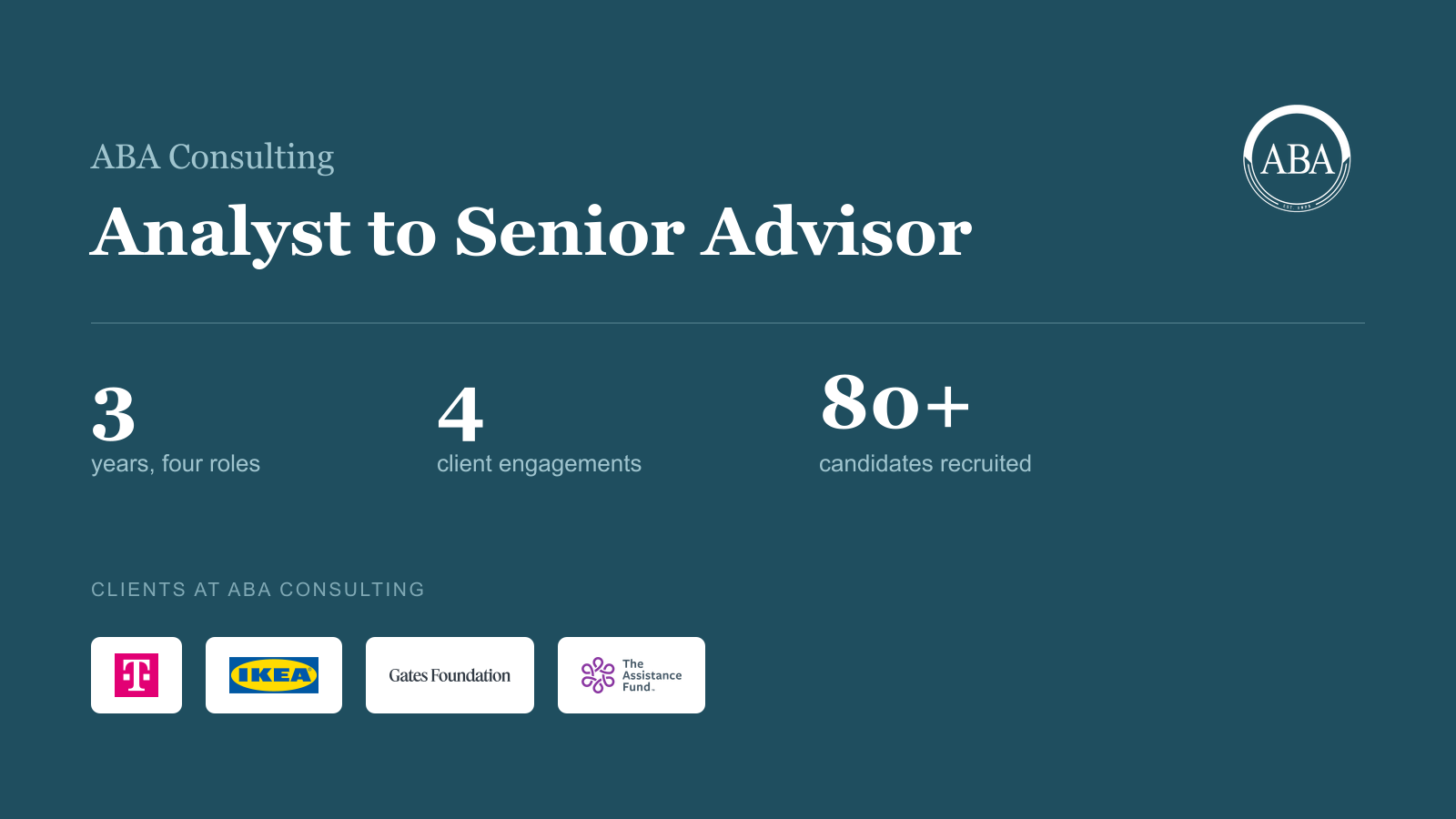
Analyst to project manager in three years: four client engagements, teams of 5 to 8, and the hiring pipeline for 80+ candidates
The arc
I joined ABA Consulting as a marketing analyst in January 2022 and left as a senior advisor in January 2025. In between I was a finance analyst, then a project manager, then part of the leadership running the organization itself.
Two jobs came with the last two roles. Deliver work a client would pay for, and build an organization that could keep producing it with people who turn over every year.
Delivery
As a project manager I sourced the clients, owned the timelines, and led analyst teams of 5 to 8 from scoping through executive delivery. Before that I worked on two engagements as an analyst. All four:
- T-Mobile (2022). Customer and industry research on Gen Z brand recognition of their 5G product, built on a 1,100+ response survey. I contributed the research as an analyst; the team delivered six research-backed strategies and an executive recommendation deck.
- IKEA (early 2023). Market entry feasibility for financial services. I built customer segmentation models and visualizations from a 1,500+ respondent survey to identify whitespace, and presented recommendations to IKEA stakeholders alongside 10+ expert interviews.
- The Assistance Fund (Jul to Dec 2023), as project manager. A 20-week growth engagement delivered on time, validated through a 3,000+ respondent survey and 15+ expert interviews, ending in a roadmap presented to client leadership.
- Gates Foundation (Jan to Jun 2024), as project manager. I built a quantitative partner-scoring methodology from 30+ peer-reviewed sources and 10+ expert interviews, led 8 analysts across 5 workstreams, and delivered the recommendation directly to the Foundation’s Manager of Strategy.
Recruiting
Selecting analysts was the highest-leverage decision the organization made and the least rigorous. Candidates were judged on impressions from short interviews, which rewards confidence and polish rather than ability.
I owned the end-to-end hiring pipeline and recruited and interviewed 80+ Berkeley candidates for analyst and project manager positions across two recruiting cycles. I also built a structured scoring system that evaluated every applicant against the same defined criteria, so candidates became comparable to each other instead of being ranked on how memorable their interview felt.
Training
New analysts arrived without the specific skills the work required, and every project lead was teaching the same things from scratch.
I led professional development workshops for 80+ club members on business analysis, market research, and consulting frameworks, and separately built internal sessions on data analysis, market sizing, and strategy frameworks plus case competition prep. Those frameworks were adopted across engagement teams rather than staying with mine.
That last part is what I care about. The material was used by people I did not manage, on projects I was not on.
Culture
An organization staffed by volunteers runs on whether people want to show up. I organized social retreats and cross-club socials with other professional organizations on campus, and organized and captained the club’s competitive intramural soccer team.
That work is easy to dismiss as soft. It is not: retention is what makes the recruiting and training investment pay off, and people stay where they have friends.
What it taught me
Running delivery and running the organization behind it are different jobs, and the second one is less visible. The engagements were the output. The hiring pipeline, the workshops, and the reason people wanted to be there are what made the next set of engagements possible without me.
That is the instinct behind most of what is on this site: build the repeatable thing, not just the deliverable.
Skills
Team leadership, end-to-end recruiting and structured candidate evaluation, training design and delivery, multi-workstream project management, client sourcing and delivery, executive presentation, survey-based primary research, process design, stakeholder management.