Projects / Recommendation engine for competitive gaming
Recommendation engine for competitive gaming
The best purchase is rarely the strongest counter, so I built a set-overlap ranking algorithm that finds it. Vanilla JavaScript, zero dependencies, one static file.
The problem
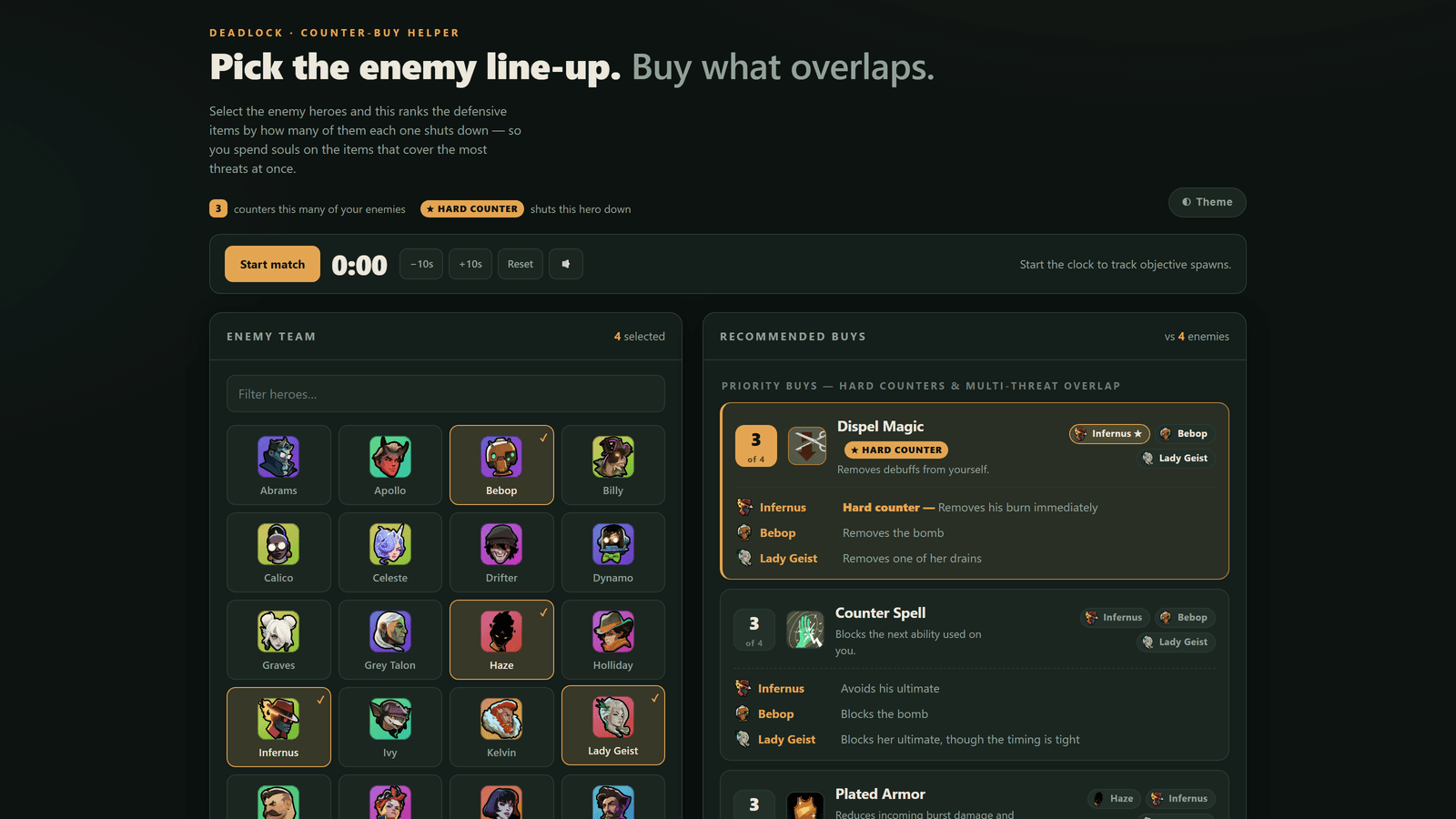
Some decisions are high-leverage while the knowledge behind them stays folklore: real, well understood by experts, and impossible to recall in the ten seconds you have to act. The case I picked is item selection in Deadlock, a competitive hero shooter where buying the right defensive items against the enemy lineup is one of the biggest swings available in a match. That knowledge lives in community guides and accumulated experience, and nowhere queryable. I turned it into one click: select the opposing lineup, get a ranked buy list with reasons attached.
The design decision
The obvious ranking signal is counter-strength: how hard does this item punish that hero? That is the wrong answer. The best purchase is usually the item that neutralizes the most enemies at once, so the app scores every item by overlap across the selected team.
Pure overlap has its own failure mode. An item that shuts one hero down almost entirely can lose to a mediocre item that happens to touch two, so hard counters get a weighted bonus and their own priority tier. The result mirrors how strong players actually prioritize, and items that backfire against specific heroes get an explicit “do not buy” warning instead of being silently ranked low.
What I built
- Ranking engine. Each item is scored as overlap plus hard-counter weighting, then split into Priority and Situational tiers with per-hero rationale and anti-recommendations.
- Structured domain dataset. I compiled a community strategy guide into a normalized model of 38 heroes and 33 items, with every counter annotated with a one-line reason. Data is fully separated from presentation, so extending it is a data edit rather than a code change.
- API integration and asset pipeline. Pulled official hero and item metadata and artwork from a public REST API, reconciled the naming mismatches between the API and the guide, then optimized and committed 71 WebP assets so the app ships self-contained with no third-party runtime calls.
- Product-grade UI. Responsive down to phone width (you use this mid-match), light and dark theming, live hero search, keyboard-accessible controls, and a visual identity that fits the game.
- Frictionless deploy. A single static
index.htmlwith no build step, hosted on GitHub Pages with push-to-deploy. It loads instantly and needs no account.
Why it’s here
It is the smallest complete example of how I work: take knowledge that only exists as folklore, model it properly, decide what the ranking should actually optimize for, and ship something a stranger can use without instructions.
Stack and skills
Algorithm and data: scoring algorithm design (weighted set overlap with tiering and exclusion rules), relational data modeling and schema design, data normalization from unstructured sources, REST API integration, reconciling mismatched identifiers across two sources.
Engineering: framework-free JavaScript (DOM rendering, application state, event handling), semantic HTML, CSS grid, custom-property design tokens, responsive layout, light and dark theming, WCAG-minded keyboard accessibility, image optimization pipeline (71 WebP assets), Git, static deploy via GitHub Pages with no build step and no runtime dependencies.