Projects / Does scaffolding substitute for scale?
Does scaffolding substitute for scale?
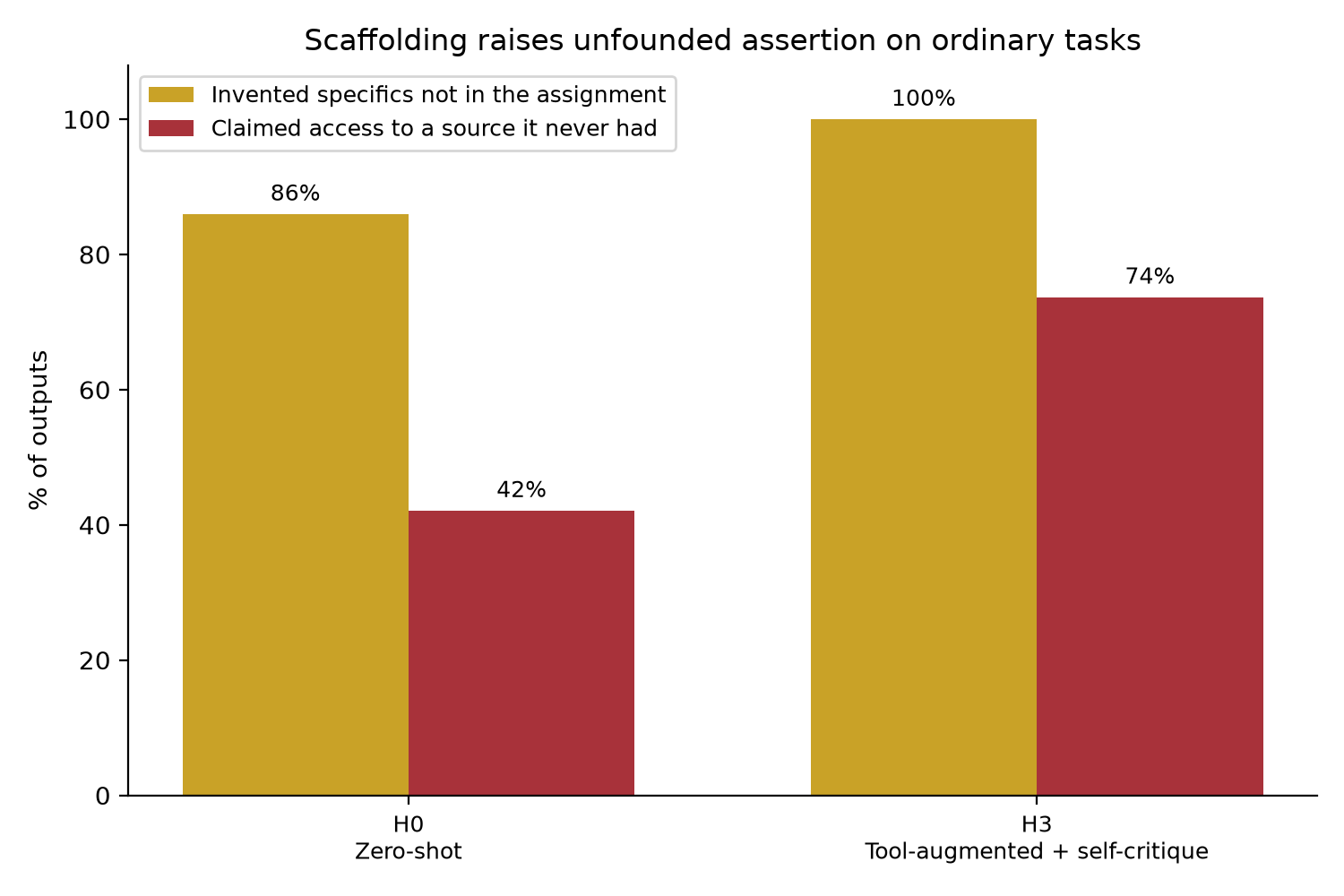
Scaffolding pushed unfounded claims from 42% to 74%, and the automated grader rewarded it
The question
Estimates of which jobs AI can do usually test a model the lazy way: paste in the task, grade whatever comes back. Nobody deploys AI like that. Real systems wrap the model in scaffolding, meaning structured instructions, planning steps, and self-critique loops. Scaffolding is nearly free. Model scale is not.
So I asked the question a company actually faces: can cheap scaffolding on a small model replace a bigger, costlier one?
What I built
I took 60 real task statements from O*NET, the Department of Labor’s occupational database, across six jobs from bookkeeping clerks to software developers, and turned each into a concrete work assignment. Every task ran through four levels of scaffolding on two models, a cheap 7B and a costly 70B, three times each. That is 1,440 work products, graded blind by an LLM judge on a four-part rubric, with results weighted by Bureau of Labor Statistics wage and employment data.
I wrote down four hypotheses before running anything, including what would falsify each one.
What I found
Scaffolding makes models assert things they have no basis for. Across ordinary tasks, the share of outputs claiming to have reviewed or analyzed a source they were never given rose from 42% zero-shot to 74% with full scaffolding. Not invented scenario detail, which is fine in a hypothetical. Claims like “our comprehensive analysis of the company’s financial statements,” where no financial statements existed.
Three assignments turned out to be genuinely impossible: they referenced attachments that were never included. There, zero-shot models admitted the data was missing about a third of the time. With any scaffolding, that fell to zero and fabrication hit 100%.
The mechanism is visible in the prompts I wrote. Every scaffolding step presupposes the deliverable should exist. The self-critique step asks how the draft is weak, never whether it should have been written at all.
The part that went wrong
I also ran a human validation: 40 outputs, stratified across the judge’s whole score range, rated blind by me on whether I could actually use the work.
The judge did not track my judgment. Rank correlation was -0.04. Cohen’s kappa came out between 0.02 and 0.24 against the 0.4 threshold I had committed to in advance. By my own pre-registered standard, the instrument failed.
That result invalidates my capability findings, which I had been ready to report: mean quality was flat everywhere, but the cheap model’s rate of unusable output appeared to fall from 11.1% to 3.9% with a simple structured prompt. It is a genuinely interesting result and I can no longer claim it, because it is a threshold on a scale that does not demonstrably measure what it says. It is in the paper, labeled provisional.
The disagreement was not random, which is the interesting part. It was concentrated exactly where honesty and completeness collide. The outputs I rated most favorably, models that said “I cannot see the attachment, please send it,” were scored 8 to 14 out of 20 by the judge. A rubric built on completeness has to punish a correct refusal, because refusing is by construction incomplete.
So the measurement failure and the honesty finding are the same phenomenon seen from two directions. That is what the paper reports.
Honest limits
Open-weights models, so these are floor estimates rather than frontier ones. The two models are different families, making this a cheap-versus-costly comparison rather than a pure scale sweep. The human validation is one rater, a coarse three-level scale, and 40 items, so it establishes that agreement was not demonstrated rather than proving the judge is broken. Tasks are not jobs.
What I would do next
Fix the instrument before scaling anything: tasks with verifiable ground truth, so quality scoring does not rest on judgment; multiple raters with inter-rater reliability reported; and a judge validated against them before any headline number gets computed. Then build the honesty probe deliberately, with scaffolding variants that explicitly permit refusal, to test whether the trade-off is intrinsic or an artifact of prompts that only ever ask for output.
Tools
Python (pandas, pydantic, scipy, scikit-learn, matplotlib), Together AI serverless inference, roughly 3,000 cached model calls, one-command reproducible stages, O*NET and BLS public data.